The 7 Levels of Change
A strategy for creativity, innovation and continuous improvement.
Einstein pointed out that the significant problems we face today cannot be solved at the same level we were at when we created them. To get different results, change, we must do things differently. The model divides change into seven distinct levels, from easy to impossible, across a spectrum of continual change over increasing levels of difficulty. Each level is progressively more complex and more difficult to undertake than the one before, and the relationship is not a straight line: difficulty explodes as the level rises.
The seven levels, and the seven levels of fear behind them
1
Effectiveness
Doing the right things
The easiest change to make is to learn the basics: what are the right things to do, and how to change enough to become effective. Twenty percent of what is being done yields eighty percent of the payoff; energy is shifted to that twenty percent.
Level 1 fear: Paralysis
Fear of doing the wrong things. Doing nothing.
2
Efficiency
Doing things right
A thorough understanding of the job or activity, to identify and then do very well those things that have the most important impact. Largely personal adjustment to new standards and procedures, with coaching from those who know the work.
Level 2 fear: Inefficiency
Fear of wasting time. Fear of doing the right things wrong.
3
Improving
Doing things better
Ways to improve or fine-tune: speed things up, shorten delivery, increase functionality, reduce downtime. Level 3 makes something more effective, efficient, productive and value-adding, frequently with customer input.
Level 3 fear: Catastrophizing
Fear of things getting worse. Seeing only the worst case.
4
Cutting
Doing away with things
Analysis of core functions, applying the Pareto Principle to stop doing the eighty percent of things that yield only twenty percent of the value. Done systemically, with all interrelationships in perspective, it produces company-wide results.
Level 4 fear: Holding on
Fear of letting go. Just-in-case fear: “let’s take everything to be safe.”
5
Copying
Doing things other people are doing
The transition from incremental to fundamental change. Copying, learning from and reverse-engineering can boost innovation at far lower cost than starting from scratch; benchmarking and then enhancing others’ processes is the hallmark of the successful innovator.
Level 5 fear: Self-doubt
Fear of not copying the right thing. Fear of being laughed at. Fear of self.
6
Diffferent
Doing things no one else is doing
Doing something very different, or very differently: degrees of novelty that move an organization out of the box and into areas where nobody else is working. A shift into 3-Sigma thinking, often by synthesizing seemingly unconnected concepts and technologies.
Level 6 fear: Normalcy
Fear of being different. Fear of being noticed. Fear of the unexpected. Fear of exposure.
7
Impossible
Doing things that can’t be done
“What is today impossible, but if it were possible would fundamentally change the way you do business?” Discoveries at Level 7 build on major mindshifts connected with exploratory thrusts into the unknown: bold, long-term visions and change so different that it cannot be compared to anything known.
Level 7 fear: Disbelief
Fear of the unknown. Fear that I can’t do that. Fear of the point of no return. The sum of all fears.
Fear is driven by reversed thinking: what could go wrong as opposed to what could go right. The Seven Levels of Fear © 1996 Mike Donahue, Colorado Mountain School.
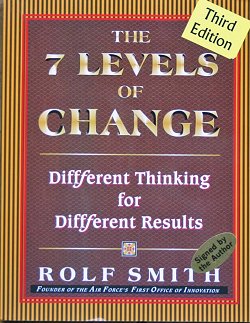
The book
The 7 Levels of Change: Diffferent Thinking for Diffferent Results
Third edition, 2011. Working from his experience as a strategist with the U.S. Air Force and as a consultant to some of the world’s largest corporations, Rolf Smith details his seven levels for creating radical, results-driven change, with case studies, 115 slides, eight mind maps, an index of more than 75 innovation tools, and the Me, Inc. process for personal change at every level. Adopted as a textbook in innovation and creativity classes at colleges and universities, including Disney University’s College Intern Program.
How to order
A copy of the third edition, personally inscribed and autographed by Rolf Smith, postage paid, is $18.45 by check or money order to The School for Innovators, ATTN: 7 Levels of Change, [postal address], or by PayPal through the basecamp address. For team quantities, personally inscribed, e-mail us with specifics. [Rolf: confirm price, address and whether to link to Amazon.]